Indian Defense: Budapest Gambit Accepted, Fajarowicz Defense
1. d4 Nf6 2. c4 e5 3. dxe5 Ne4
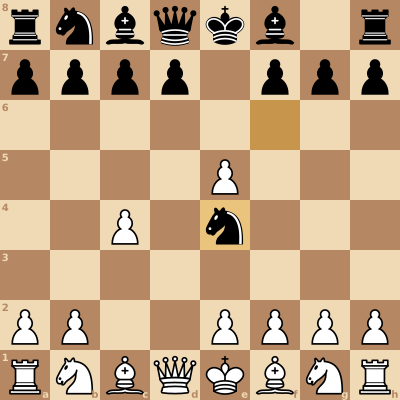
The Indian Defense: Budapest Gambit Accepted, Fajarowicz Defense is a chess opening classified as ECO A51, reached after 1. d4 Nf6 2. c4 e5 3. dxe5 Ne4. It is a line of the Indian Defense. White is to move. 2 named lines continue from this position.
In 12.6 million rated Lichess games (blitz and slower), this position was reached 1,458 times by this move order. White won 47%, 5% were drawn and Black won 48%. The most popular continuation is 4. Nf3 (41% of games).
Engine evaluation: +1.27 (Stockfish, depth 60; best line 4. a3 b6 5. g3 Bb7 6. Nf3 Bc5)
- ECO
- A51
- Moves
- 6 plies
- FEN
rnbqkb1r/pppp1ppp/8/4P3/2P1n3/8/PP2PPPP/RNBQKBNR w KQkq - 1 4- PGN
1. d4 Nf6 2. c4 e5 3. dxe5 Ne4
Analyse with Stockfish · Board image (SVG) · Open on Lichess
Results by rating
| Average rating | Games | White / draw / Black |
|---|---|---|
| 0-1499 | 115 | |
| 1500-1999 | 718 | |
| 2000+ | 625 | |
| All | 1,458 |
Most played moves
| Move | Games | White / draw / Black |
|---|---|---|
| 4. Nf3 | 594 (41%) | |
| 4. a3 Budapest Gambit Accepted, Fajarowicz Defense, Bonsdorf Variation | 224 (15%) | |
| 4. Nc3 | 108 (7%) | |
| 4. Nd2 | 105 (7%) | |
| 4. Qd4 | 97 (7%) | |
| 4. Qc2 Budapest Gambit Accepted, Fajarowicz Defense, Steiner Variation | 72 (5%) | |
| 4. f3 | 61 (4%) | |
| 4. e3 | 54 (4%) |
Master games
521 over-the-board games are classified under this line (White 44%, draw 16%, Black 40%). The strongest:
- Stockfish dev16_202209170930 (3611) – rofChade 3.0 (3486) 1-0 · TCEC 23 Premier 2022 · 2022-09-30
- rofChade 3.0 (3486) – Stockfish dev16_202209170930 (3611) 1/2-1/2 · TCEC 23 Premier 2022 · 2022-09-30
- Stockfish dev-20230903-b25d68f6 (3666) – SlowChess Blitz 2.9 avx2 (3418) 1-0 · TCEC 25 Premier 2023 · 2023-09-06
- SlowChess Blitz 2.9 avx2 (3418) – Stockfish dev-20230903-b25d68f6 (3666) 1/2-1/2 · TCEC 25 Premier 2023 · 2023-09-06
- GM Baadur Jobava (2603) – GM Evgeny Postny (2600) 1-0 · PNWCC Online Blitz JP 14 · 2020-06-20
Highest-rated Lichess games
- LegendOfTheLounge (2720) – GolfeDuMorbihan (2689) 0-1 · 2026-09-06 · 180 + 0s
- AbcD7-34-6 (2629) – GolfeDuMorbihan (2699) 1-0 · 2026-09-03 · 180 + 0s
- SexDrugsRnR (2588) – GolfeDuMorbihan (2692) 0-1 · 2026-09-03 · 180 + 0s
Comes from
Indian Defense: Budapest Gambit Accepted 1. d4 Nf6 2. c4 e5 3. dxe5
Continuations
- Indian Defense: Budapest Gambit Accepted, Fajarowicz Defense, Bonsdorf Variation A51 · 1. d4 Nf6 2. c4 e5 3. dxe5 Ne4 4. a3
- Indian Defense: Budapest Gambit Accepted, Fajarowicz Defense, Steiner Variation A51 · 1. d4 Nf6 2. c4 e5 3. dxe5 Ne4 4. Qc2
More Indian Defense lines (all)
- Indian Defense: Pseudo-Benko A43
- Indian Defense (1. d4 Nf6) A45
- Indian Defense: Accelerated London System A45
- Indian Defense: Gedult Attack A45
- Indian Defense: Gibbins-Weidenhagen Gambit A45
- Indian Defense: Gibbins-Weidenhagen Gambit Accepted A45
- Indian Defense: Gibbins-Weidenhagen Gambit, Maltese Falcon A45
- Indian Defense: Gibbins-Weidenhagen Gambit, Oshima Defense A45
- Indian Defense: Gibbins-Weidenhagen Gambit, Stummer Gambit A45
- Indian Defense: Lazard Gambit A45
- Indian Defense: Maddigan Gambit A45
- Indian Defense: Omega Gambit A45
Opening names and moves from the Lichess openings dataset; statistics from the Lichess open database, 2026-09 (CC0), sample of 12.6 million games, bots excluded; evaluations from Lichess cloud analysis (all CC0). Master games from The Week in Chess #920–#1664 by Mark Crowther, used with permission.